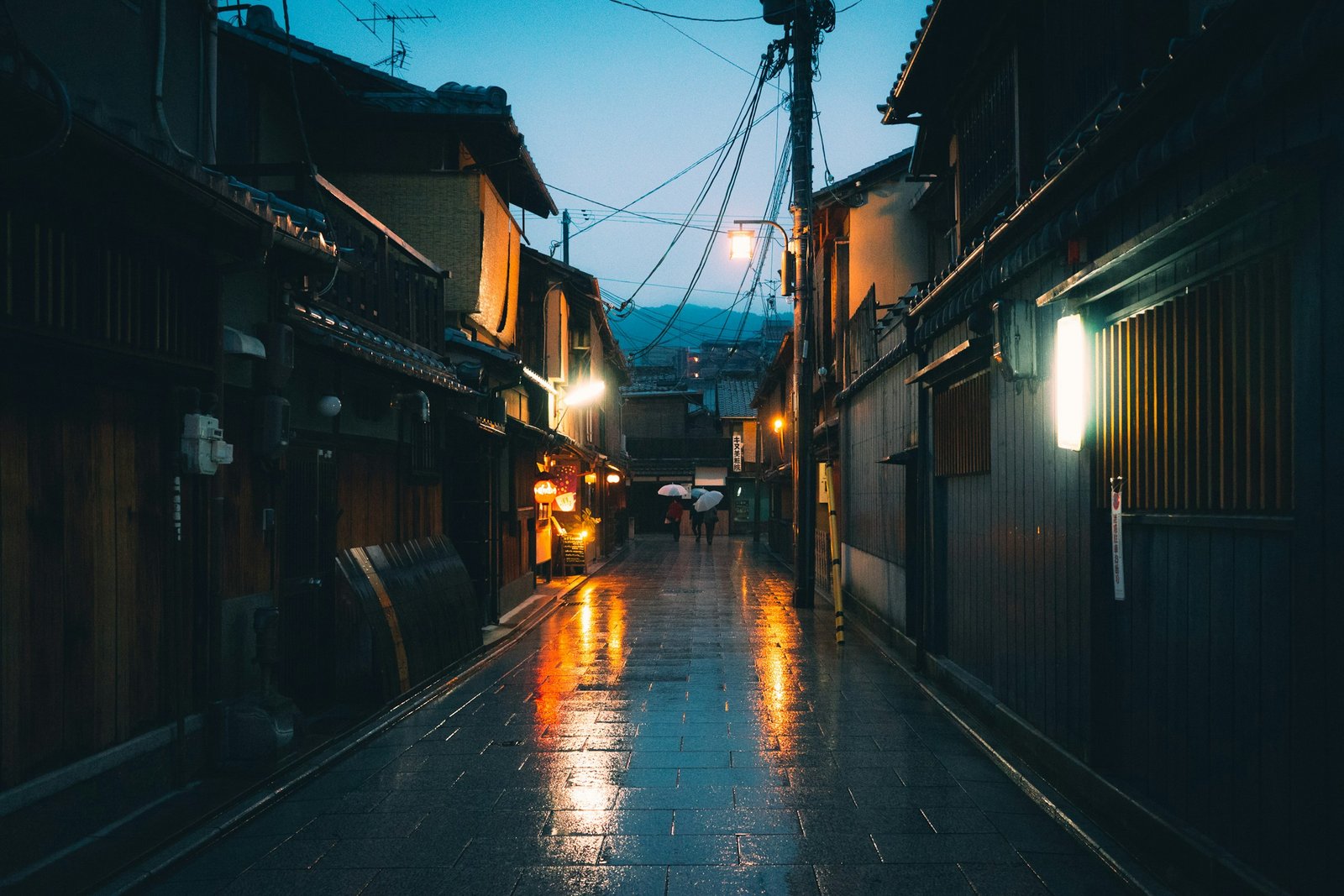
Two weather patterns get Japan's early summer written off in travel advice: the rainy season and the typhoon season. Both are real, and both are routinely described in a way that makes them sound worse than they are. This guide covers when each actually happens, what they do to a trip in practice, and when they are genuinely worth rearranging plans around.
When the rainy season runs
Japan's rainy season runs from roughly early June to mid or late July in the Tokyo and Kyoto regions, and it moves south to north across the country. Okinawa runs from early May to late June; Kyushu and Shikoku from late May or early June into mid-July; the Tokyo and Kyoto regions from roughly early June to mid or late July; and Tohoku later still. Hokkaido is generally considered not to have one at all.
What it actually feels like
The most useful thing to know is that the rainy season is not weeks of continuous rain. In practice it means high humidity with heavy bursts — a downpour that soaks a street and stops, followed by grey warmth or sudden sun. Whole days are lost to rain much less often than the name implies.
What it does reliably deliver is humidity, which matters more for comfort than the rain does. Temples and gardens look extraordinary in wet weather, the moss is at its best, and the famous places are noticeably less crowded. For a traveller willing to carry an umbrella, June is one of the better-value months of the year.

When typhoon season matters
Typhoons are possible in Japan from roughly May through October, with the peak in August and September. Okinawa, Kyushu and Shikoku are the most exposed; direct hits on Tokyo and Kyoto are less common, though disruption to transport from a storm passing nearby is not.
How disruption actually works
Japanese rail operators announce planned suspensions in advance rather than cancelling services as a storm arrives. That practice is unfamiliar to most American travellers and is genuinely reassuring: you usually know the day before that a line will stop running, which gives you time to move a plan rather than being stranded by it.
A typhoon that affects your trip will most likely cost you one day, not a week. The sensible response is to keep a flexible day in the plan and avoid scheduling anything unmissable — a long-distance journey, or the flight home — for the tail end of a trip in early September.
Should you avoid the summer entirely?
Summer in Japan is worth taking on its own terms rather than avoiding outright, and its real problem is heat rather than either weather pattern. August highs in Tokyo and Kyoto run around 33 to 35C with high humidity, and Kyoto's basin geography makes it feel hotter still. That is a genuine constraint on how much walking a day can hold, and it is the reason August itineraries need to be lighter than spring ones.
Set against that, summer carries the festival calendar, long daylight, and the mountains and northern regions at their most pleasant — Hokkaido in August is excellent. Summer is not a season to avoid so much as one to plan differently.
If your dates are fixed in early summer
June and early July are genuinely good months to travel in Japan provided you plan for the humidity: early starts, indoor anchors in the middle of the day, and no assumption that every afternoon will be dry. Prices sit below both peak seasons and the major sights are calmer than at any other point between March and November.
Early summer, month by month
June, July and September differ enough from one another that treating early summer as a single block is misleading. June carries the rainy season and the lowest crowds of the warm half of the year; July turns hot once the rains lift in the middle of the month; September sits at the typhoon peak while the heat finally begins to ease. Each asks for a different kind of itinerary.
June
June carries the rainy season across most of the main island and is, for that reason, one of the quietest and best-value months in the calendar. Gardens are at their most saturated, the famous sites are noticeably calmer, and the temperature is warm rather than punishing. The cost is humidity and an umbrella in the bag every day.
July
July begins wet and ends hot, with the rainy season lifting somewhere in the middle and the serious heat arriving behind it. The second half of the month starts to demand the lighter, slower kind of itinerary that August requires outright.
September
September sits at the peak of the typhoon season while the heat begins to ease, which makes it a month of trade-offs rather than a straightforward improvement on August. The back half is generally more comfortable than the front, and the crowds are lighter than either peak season.
Building a plan that survives a lost day
A Japan trip in August or September should be built to absorb one lost day, because that is the realistic cost of a typhoon passing near Tokyo or Kyoto rather than the week-long disruption travellers fear. Building that slack in costs very little.
The practical version is to avoid scheduling a long-distance journey or anything unmissable on the final days, and to keep one flexible afternoon in reserve rather than filling every slot.
Because suspensions are announced ahead rather than sprung on passengers, the warning usually arrives with enough time to reorder a plan. What it cannot do is create space in an itinerary that had none, which is the real argument for planning early summer more loosely than spring.
Choosing a season on purpose
Weather is only one input into when to visit Japan, and rarely the decisive one — the rainy season's six weeks and the typhoon peak in August and September matter less to most itineraries than the holiday clusters do.
Weather interacts with those clusters, with lodging prices, and with how much ground an itinerary can cover — a choice that cascades into how many bases you use and how far ahead you commit. Comparing the seasons against each other is a more useful exercise than ruling any single month out.
How that timing decision then reshapes the route, the bases and the booking order underneath it is what the complete Japan trip guide is built to work through.