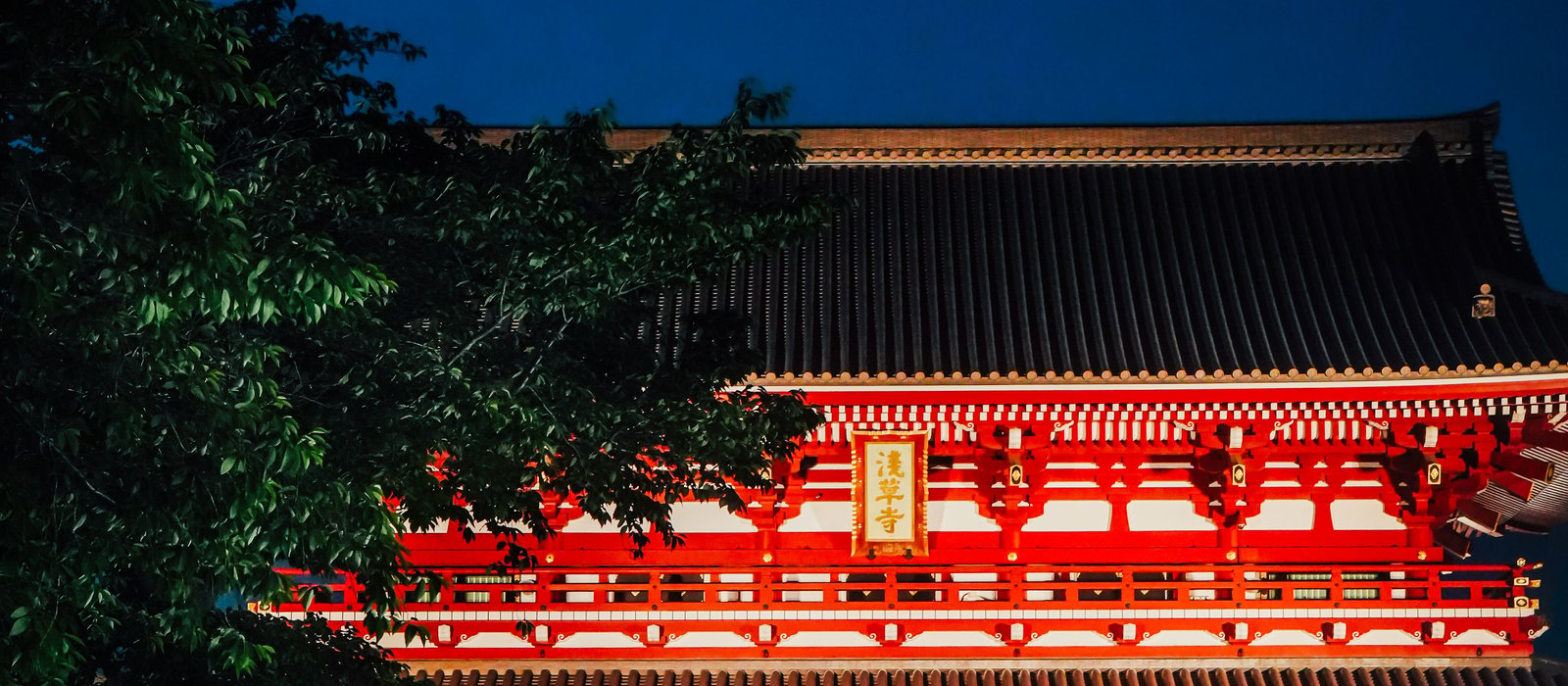
Senso-ji, in Tokyo's Asakusa district, is the city's oldest and most famous temple and one of its essential sights. Founded, according to legend, in the 7th century around a tiny statue of the goddess Kannon pulled from the nearby Sumida River, it has been a center of worship and bustle for over 1,300 years, making it older than the city of Tokyo itself in every meaningful sense. With its grand gates, lively approach, and historic atmosphere, it's the best place in Tokyo to feel the city's traditional soul. Here's a complete guide to visiting.
What you'll see
Kaminarimon (Thunder Gate)
Your visit begins at the iconic Kaminarimon, the outer gate famous for its enormous red paper lantern weighing around 700 kilograms, flanked by guardian statues of the gods of thunder and wind. It's one of Tokyo's most photographed landmarks and the symbolic entrance to the temple — expect a crowd posing beneath the lantern.
Nakamise shopping street
Beyond the gate stretches Nakamise, one of Japan's oldest shopping streets, lined with stalls selling traditional snacks, sweets, fans, folding combs, and souvenirs. It's a fun, atmospheric walk of a couple hundred meters up to the temple — grab a freshly made treat along the way, like ningyo-yaki (small filled cakes), age-manju (deep-fried buns), or a senbei rice cracker grilled in front of you. Many of these shops have been run by the same families for generations, some for well over a century, which is part of why Nakamise feels different from a typical tourist-strip souvenir row.
The main hall and grounds
At the end of Nakamise stands the second gate (Hozomon) and the grand main hall (Hondo). In front of it sits a large bronze incense burner, where visitors waft the fragrant smoke over themselves for good health and fortune. Beside the hall rises a striking five-story pagoda, and the surrounding grounds — including a small garden and the Asakusa Shrine next door — are atmospheric and free to explore.
When to go
Senso-ji is hugely popular and can be shoulder-to-shoulder by midday. For the best experience, visit early in the morning before the crowds and the Nakamise stalls fully open (the temple grounds are accessible around the clock), or in the evening, when the gates, pagoda, and main hall are beautifully illuminated and the area is far quieter. Both times are genuinely magical and far more pleasant than the midday crush. The temple is also spectacular during seasonal events and festivals, though those bring their own large crowds.
Combine with nearby sights
Senso-ji sits in Asakusa, a district full of old-Tokyo charm — wander the backstreets beyond Nakamise for craft shops, traditional sweet makers, and old-style restaurants, or take a rickshaw tour. The Sumida River is a short walk away, with riverside paths and sightseeing cruises. And just across the river rises Tokyo Skytree, an easy add-on for sweeping views from one of the world's tallest towers. Together, Senso-ji and Skytree make a perfect half-day pairing old and new Tokyo, best walked in that order so the modern skyline feels like a payoff rather than a warm-up.
Etiquette and tips
- Be respectful — Senso-ji is an active Buddhist temple as well as a tourist site, with people coming to pray.
- At a Buddhist temple you pray quietly with hands together, without clapping (clapping is for Shinto shrines).
- You can take part in customs like wafting incense smoke for good fortune, or drawing a paper fortune (omikuji) — if you draw a bad one, tie it to the nearby rack to leave the bad luck behind.
- The grounds are free; carry small change for snacks, charms (omamori), fortunes, and offerings.
- Photography is fine in the general grounds; be mindful inside halls and around worshippers.
- It's very walkable and well connected by subway, just steps from Asakusa Station.
A temple that has been rebuilt more than once
The current main hall isn't the original — the temple has burned down and been reconstructed several times across its history, most recently after it was destroyed in the WWII bombing raids of 1945; the present hall dates to 1958, rebuilt in reinforced concrete designed to withstand fire and earthquakes going forward, though it faithfully follows the traditional design. That continuity — the same site of worship for over a millennium, rebuilt again and again rather than abandoned — is part of what gives Senso-ji its weight, even though the building itself is decades, not centuries, old.
Bottom line
Senso-ji is a Tokyo must-see that captures the city's traditional heart. Visit early or in the evening to enjoy it at its atmospheric best, savor the street snacks along Nakamise, take part in the incense and fortune customs, and pair it with Tokyo Skytree for a memorable half-day spanning old and new Tokyo.